IPPT Deferment Explained: A Working NSman’s Guide to MCs and Exemptions
For a working NSman, the main thing to know is that IPPT issues can usually be managed legally if you act early and follow the correct process. Missing one booked session is not the same as defaulting your yearly requirement, a civilian MC is only useful after you upload it in OneNS for official endorsement, and a full annual exemption usually needs a serious documented condition with MCs adding up to 6 months continuous or 9 months cumulative in the same 12-month window.
What many people call “deferment” does not mean delaying the whole IPPT window, and real deferment is only considered for approved reasons like ICT conflicts, major life events, exams, new job or business demands, family emergencies, overlapping call-ups, or national representation, with documentary proof required.
Introduction
When your Operationally Ready Date, or ORD, anniversary or birthday has passed, the 12-month IPPT window starts officially ticking down, and that time of year can feel heavy for any Working NSman. I have seen how a demanding corporate career can make it harder to keep up with training, especially when sudden anxiety kicks in over pulling a muscle just weeks before the fitness test. If you get injured, face an unexpected life crisis, or feel stressful pressure because your test is due, it is normal to panic.
What matters is knowing there are official, legally recognized ways to manage your National Service fitness requirements without risking disciplinary action. This guide explains when you may defer, how to validate a civilian medical certificate, how MCs work, when you may qualify for exemptions or a full exemption, and how to protect your record properly. From experience, keeping your documents clear and acting early makes it much easier to handle the process and avoid trouble while staying within the rules.
The Panic of Missing a Session vs. Defaulting
In my early days as a working NSman, I once booked a Tuesday evening IPPT and got stuck in the office with a late client. I completely missed my slot and genuinely panicked, thinking I would be charged the next morning for Absent Without Official Leave or AWOL. That kind of moment can really test your nerves, especially when work schedules are unpredictable and you already have enough stress to handle.
But let me save you from that fear: the system is more understanding than many people think. You just need to know exactly where the hard lines are drawn, because there is a massive difference between missing a single training session and missing your entire yearly requirement. Once you understand that gap clearly, it becomes much easier to respond properly instead of letting panic take over.
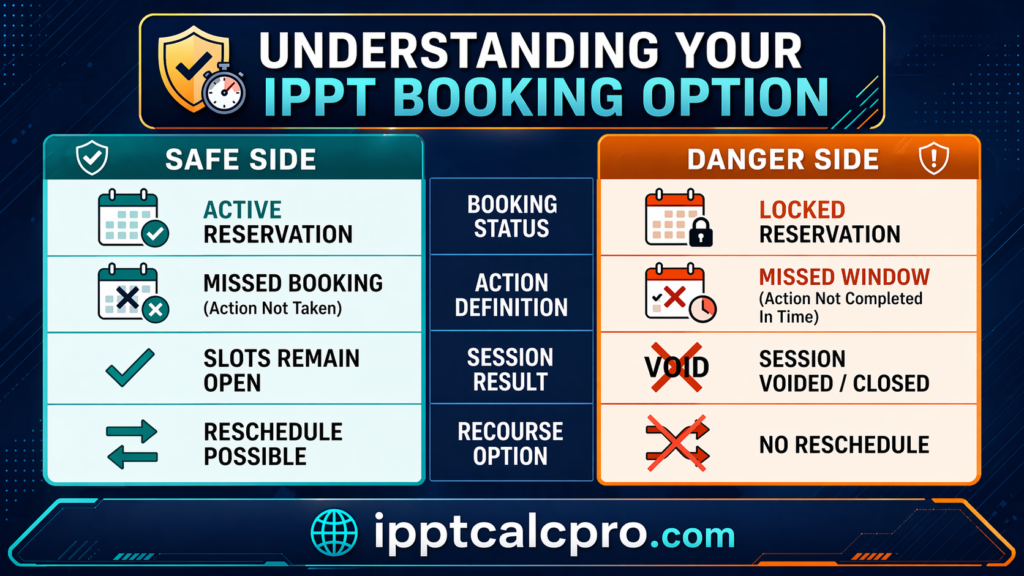
| The Situation | What It Means | What You Should Do | Possible Outcome |
|---|---|---|---|
| Missed Your FCC Session | You did not turn up for one booked FIT or FCC session, but this does not mean you failed your full IPPT year. | Sign in to the NS portal again and reserve another available session as soon as possible. | Usually no direct penalty. In most cases, you can simply rebook and continue normally. |
| Missed the 12-Month IPPT Window | Your personal IPPT deadline has ended before you completed the required attempt or requirement for the year. | Wait for the official notice, then follow the instructions and attend the required process or hearing. | This is serious. You may be treated as a defaulter and face formal disciplinary action. |
The Medical Excuse: How to Actually Use an Outside MC
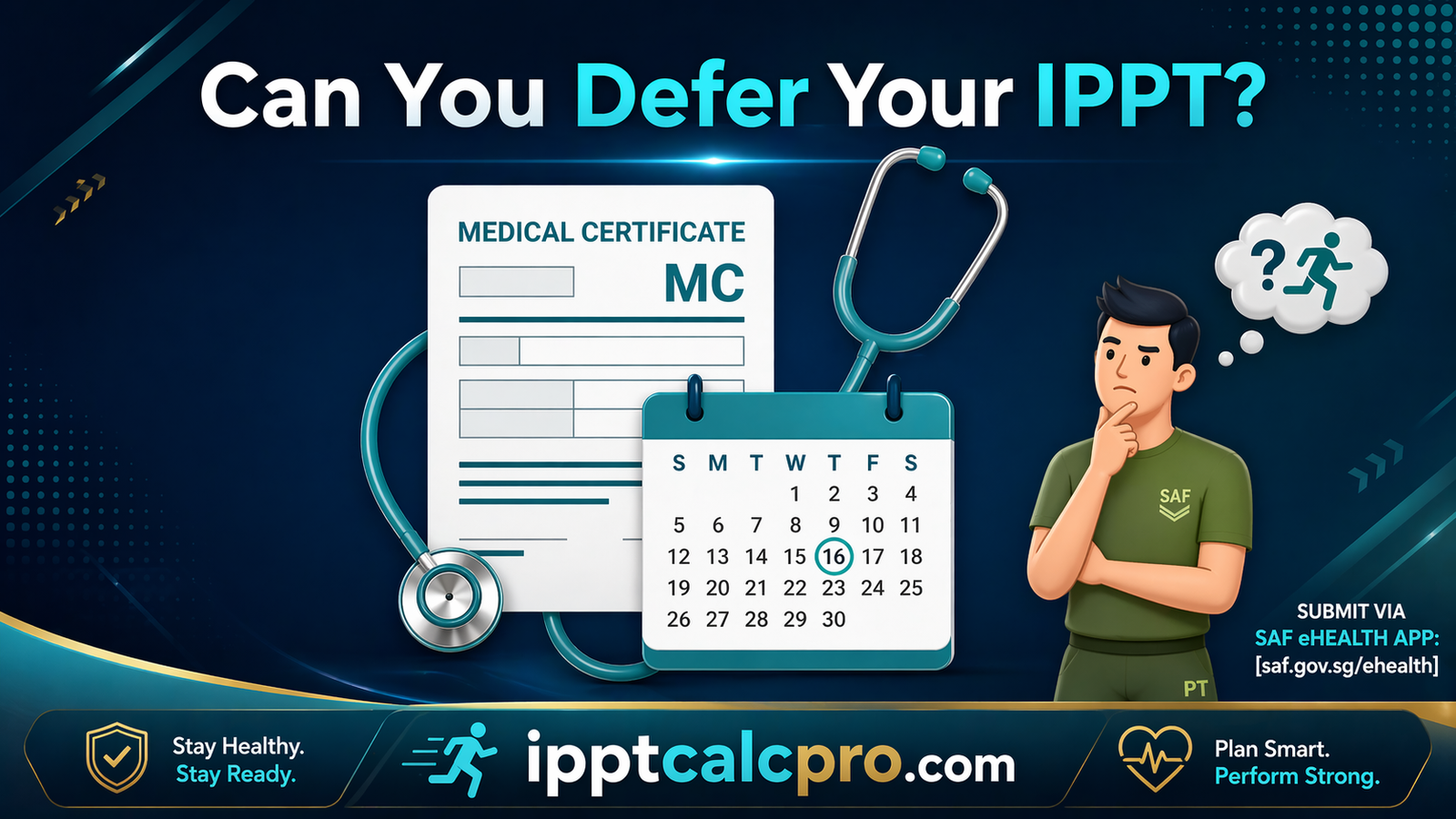
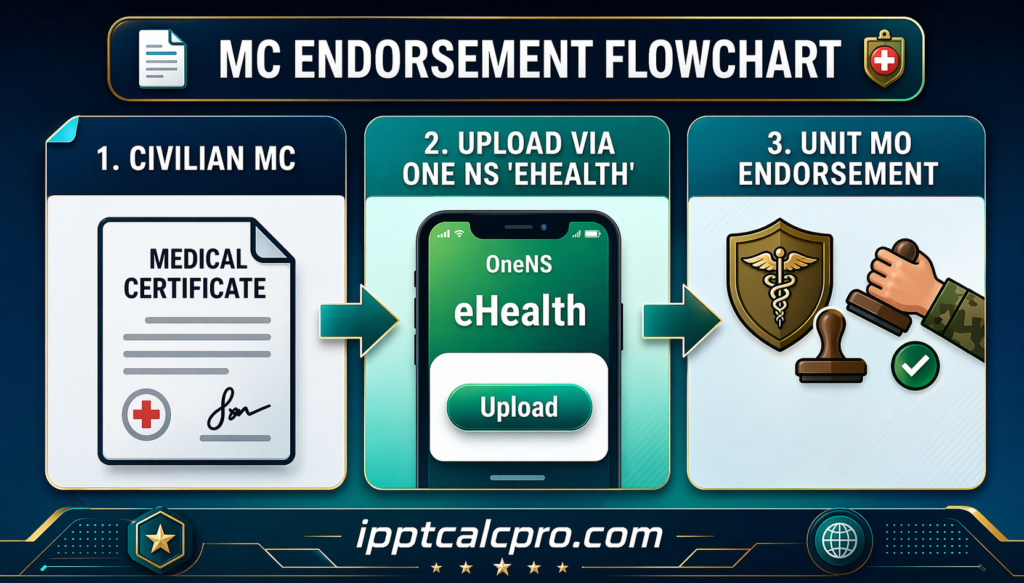
I learned the hard way that keeping a medical certificate or MC from your family doctor in your wallet does not automatically protect you when IPPT problems come up. A piece of paper means very little if the system does not know about it, even if your civilian MC from a local clinic or hospital is completely valid. You cannot just hold onto it, assume you are excused, and move on; you need to digitize it so it becomes officially recognized by the military. From what I have seen, this is the step many people miss, and that small mistake can create a much bigger headache later.
Follow these 3 exact steps to protect yourself:
- Get Your Civilian MC: See your doctor, get proper treatment for the injury or illness, and make sure the MC clearly shows the number of rest days you have been given.
- Log Into the Portal: Open the OneNS portal on your phone or computer, then head to the Manage Medical (eHealth) section.
- Upload and Wait for Endorsement: Upload a clear image of your MC, then your unit’s Medical Officer (MO) will review it and formally record the excuse in the system.
If the injury is serious or expected to last for some time, the Medical Officer may ask you to return for a medical board review and consider a temporary PES downgrade.
The Holy Grail: Criteria for Full Annual Exemption
One huge myth that goes around every unit is that a lot of guys believe a 5-day MC for a bad fever right before the window closes means they have successfully found a keng way out of IPPT for the entire year, but that is entirely false. In real life, if you are given a full 12 months to clear your fitness requirement, the military expects you to recover and take the test later, not disappear from the system just because of one short illness.
From what I have seen, a full exemption for the current window only happens when there is a very serious, documented, medical hurdle that clearly prevents you from completing the test safely. That is the part many people miss, because normal sickness may delay the test, but it usually does not remove the duty for the whole year.
From what I have seen, the threshold is very specific: your MCs must add up to 6 months of continuous medical excuse or 9 months cumulative within the same 12-month window. Anything less and the system still expects you to attempt the test once you have recovered. If your MCs do not hit those exact numbers, you still need to put on your running shoes when you are healed, because that is usually when the medical excuse clears and you are ready to get back on the track.
To take the guesswork out of training, I always tell people to use an IPPT Calculator to map out the exact reps needed for a Gold payout before they restart. It gives you a clearer target and helps you return with a proper plan instead of wasting sessions trying to figure everything out on your own.
The “Deferment” Reality (Valid MHA/MINDEF Reasons)
When people say they want to defer their IPPT, that is often the wrong word. Since IPPT works through a 12-month window and not a single specific date, you cannot really defer the window itself. What you can do is apply for deferment in certain situations, especially if you are being called up for In-Camp Training (ICT), if you have defaulted, or if you are being called back for Mandatory NS FIT sessions. From what I have seen, understanding this difference early saves a lot of confusion and helps people take the correct step instead of assuming the whole system can just be pushed back.
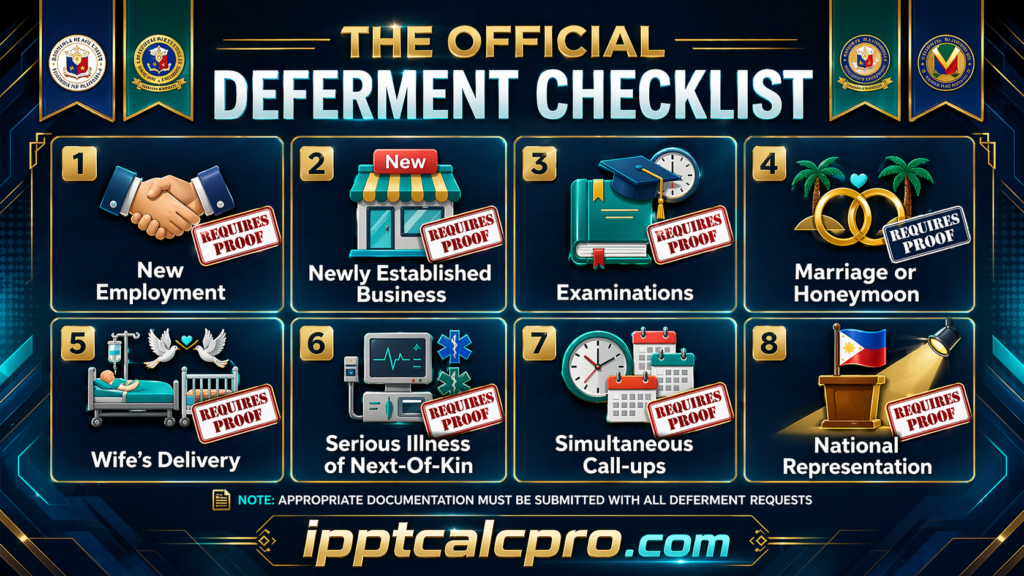
The Ministry of Home Affairs and MINDEF are usually quite strict about deferments because it affects unit readiness. Still, an application may be approved when there is a genuine major life event and one of the officially recognized reasons applies. The key point is simple: your request needs proper documentary proof, because without that, the case usually does not move very far.
- Starting a New Job: You have recently joined a company and are still in your probation period.
- Running a New Business: You are in the important early stage of building and settling your business.
- Major Exams: You are preparing for or taking important academic or professional exams.
- Wedding or Honeymoon: Your NS call-up directly overlaps with your wedding dates or honeymoon plans.
- Wife’s Delivery: Your wife is expected to give birth during the call-up period.
- Serious Family Illness: You are the main caregiver for an immediate family member who is seriously unwell.
- Overlapping Workplace Call-ups: Two or more NSmen from the same department are called up at the same time, affecting company operations.
- National Representation: You are representing the country in regional or international games.
Even when your deferment gets approved, you will usually still need to complete make-up training within the same work year. It gives you extra time, not a full waiver.
he Finish Line: Permanent Exemptions
For many of us, the day we look forward to is when an NSman can finally put away the running shoes, leave the annual 2.4-kilometer run behind, and stop worrying about constant physical training. From what I have seen, that point eventually comes when a person ages out or phases out of the physical training system.
Once you reach any of the milestones below, you become permanently exempt and no longer need to keep track of your annual window.
- MINDEF Reserve (MR): You have completed your required ORNS training cycles and are now placed in MR.
- Age Limit for Officers: You have reached the age of 45.
- Age Limit for WOSEs: You have reached the age of 40, which applies to Warrant Officers, Specialists, and Enlistees.
- Permanent Medical Downgrade: You have been officially downgraded on a permanent basis to PES B3 or below.
Do keep in mind that if you are in PES C1, you are still fully eligible and still required to complete your annual IPPT. A lot of people get this wrong, so it is worth being careful about.
Conclusion
That Tuesday evening when I missed my FCC slot, I simply rebooked the next morning, took the test two weeks later, and cleared it with no bad record from the missed session. That is how the system really works when you know the rules and understand the difference between missing a booking and missing your window.
From experience, once your MCs are endorsed properly, there is usually no reason to panic every time a MINDEF envelope shows up. Most problems feel worse only when you do not know the process, but once you understand it, the whole thing becomes much easier to handle.