
IPPT Test Day Protocol: What to Eat, FCC Tips, and How to Stay Safe from No-Counts
As your booking gets closer and the clock ticks down, even well-prepared guys can feel the nerves, no matter how solid their training has been with the IPPT Calculator and planned reps. From what I have seen at the FCC (Fitness Conditioning Centre), a man who can do 60 push-ups in training can still get No-Counted to 35 if he does not know how to play the ELISS machine, and even a sub-10 minute runner can cramp up if he ate heavy prata two hours before flag-off, so a Professional test-day protocol is the one thing to follow if you want to pass and perform at your absolute peak.
The 3 Hour Rule: Fuelling the Engine
On test day, many disasters begin in the stomach, not the muscles, and I have seen strong guys cramp up halfway through the run at Bedok Stadium and Maju FCC because they ate the wrong thing at the wrong time. This rule may look simple, but it quietly saves scores when your body needs to stay light, settled, and ready.
T – 3Hrs: Your Last Real Meal
Three hours before your reporting time, have your final proper meal and keep it boring, familiar, and built around complex carbs that release energy slowly.
From what I have seen on day sessions at the track in Kranji and Khatib Camp, it is smart to avoid oily food, fried stuff, heavy sauces, and dairy, because they can sit in your gut like lead once you start running, and that heavy feeling often turns into cramps very fast; if you feel nervous, that is even more reason to skip anything adventurous and simply eat safe.
The Sugar Spike Trap
Before the test, skip sweets and energy drinks in the last 30 minutes, because they may feel shiok at first but often crash hard midway through the 2.4Km. I have seen people charge off the gate and look strong for one kilometer, but steady energy always beats sudden hype when it is time to hold pace.
Hydration Done Right
Do not suddenly drink a full litre of water right before the test, because that heavy, sloshing feeling can throw off your breathing once you begin. From my experience, it is much better to sip water steadily from the morning and keep it simple: if your urine looks light or clear, your body is usually in a good place to go.
Pro Tip Card: The FCC Survival Snack
If you are coming straight from the office, a banana with a black coffee around 45 minutes before reporting can work really well. It gives you quick fuel without leaving you feeling bloated, and in my experience, it is one of the simplest low-cost options that still feels steady and reliable.
Dynamic vs static, the warm-up secret
Listen, at Bedok Stadium, Maju FCC, and Kranji Camp, I keep seeing guys come early, look very hardworking, then sit down and start pulling hamstring for 30 seconds or 40 seconds with a very serious face, thinking more stretch means a better run. In real IPPT prep, that is one of the biggest warm-up mistakes, because when you hold a long stretch before push-ups or running, the muscle gets too relaxed, your power and snap drop for a while, and when the test starts, the body can feel flat, not injured, but unable to fire properly, so the first lap already feels heavy and very sian
What you want is not sleepy muscles but awake muscles, and that is where Dynamic warm-up works better because it tells your brain and body that work is coming. I always tell My trainees that warm-up should feel like switching on lights, not lying down to sleep, so keep it simple with a five minute routine that gets the heart rate up, the joints moving, the muscles warm and springy, your breathing slightly faster, and you mentally ready, not tired, just ready to perform.
FCC Survival Tips & Tricks: Beating the ELISS Machine
At FCC Camps, this part is not only about fitness but also about understanding how the ELISS machine works, because the machine is not against you, yet it will not help you either. From what I have seen, if you do not move in a way it can recognise, then being strong is no use.
First the sit up station
At the sit up station, keep your heels firmly planted with no floating or shifting, because many people lose counts when their feet keep moving slightly. As you go down, do not flop back; keep control, let your shoulder blades touch the mat with clear contact, and as I tell my guys, imagine a soft click—not a slam, not a half touch, just clear and confident movement, because if you rush, the sensor sometimes misses, and then you get pek chek and swear you completed the rep.
Now push ups
For push ups, keep your hands right under your shoulders so your body angle stays correct and the camera can read your chest depth properly. I always tell people not to let the elbows flare like chicken wings; keep the body straight like a plank, from head to heel, in one line, because that is the easiest way to avoid a no count.
Clothing really matters more than people think.
Do not wear loose or baggy shirts, because when a shirt hides your body line, the camera may miss the hinge of your movement and fail to read properly. I have seen people lose five to eight reps over this, so tuck in if needed and save yourself that extra sian feeling.
Pro Tip: A Trainer’s Take on the Eye Contact Rule
At the push up station, avoid checking the screen again and again. Even a small lift of the head can change your chest position enough to trigger a no count. Keep your neck neutral, fix your eyes on the floor, and stay locked into your own rhythm while the beeps come naturally.
The 2.4 km Mental Game
At Bedok Stadium and Kranji Camp, I have seen this same story repeat hundreds of times: the run is not only about legs, it is also about the head. In lap one, many people destroy their own test by watching fast runners take off, trying to chase them, and letting ego take over, but by halfway they are already breathing too hard, so my advice to trainees is simple—do not run other people’s race, stick to the pace you planned earlier, make it your anchor, lock onto it, and let the rabbits go.
Second and third laps are where you settle.
In my experience, the second and third laps are where smart runners calm the mind and lock into a steady pace instead of sprinting too early, and this little hack helps many people more than they expect: find someone slightly faster than you, stay one or two meters behind, and let them set the rhythm so you can simply follow and run without having to overthink every step; at Khatib Camp, this works especially well because the track feels open and sometimes windy, so sitting in just the right spot can save a bit of energy without even realizing it.
Final 400 meters.
The Final 400 meters is where marks are won or lost, because your brain will tell you to slow down when your legs feel heavy and your breathing turns messy, but that voice is lying and there is still more inside than most guys think; I have seen many who thought they were done suddenly find another gear the moment they decided to commit, and that is why I always tell my trainees one thing: when you feel like stopping, that is the start of the real work, so do not be kiasi, push through, empty the tank, and cross the line knowing you gave everything.
The Peak Performance Timeline
This gives you a clear step by step countdown to follow on test day.
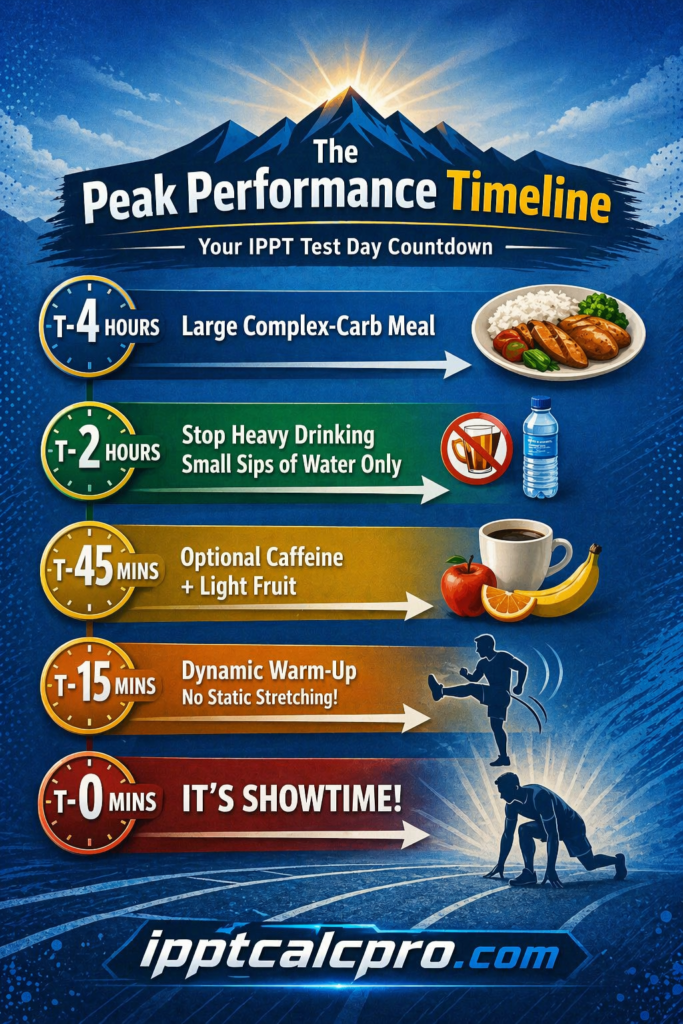
The Calm and Ready Protocol
In IPPT, I once had a trainee last year who kept failing three times, not because he was unfit, but because he was unprepared for test day itself, so instead of changing his training too much, we changed what he ate, how he warmed up, and how he approached the ELISS stations; on his next attempt, he hit Silver because the work was already inside him, he just needed to stop getting in his own way, and that is why I always say this protocol is not only about muscles but also about confidence—when you walk into Maju FCC with a clear plan, proper fuel, and a feel for how the system works, your mind stays calm, there is less kan cheong, and you can simply execute, rep by rep, lap by lap.