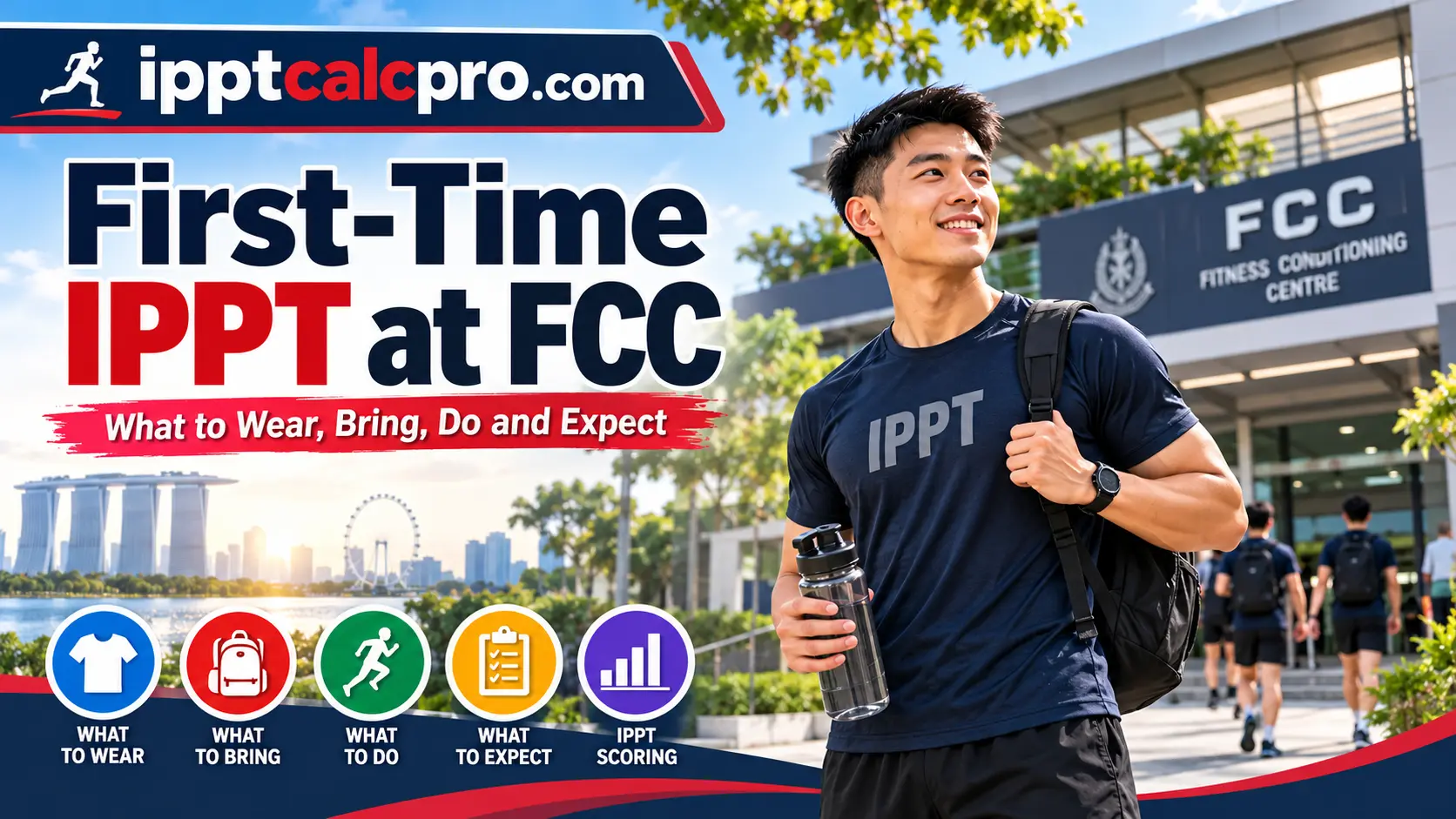
First-Time IPPT at FCC: Complete 2027 Guide
Your first IPPT at an FCC can feel a little intimidating, especially when you don’t know where to report, what to bring, or how the testing process works. You might be wondering whether you need to book in advance, how early you should arrive, or what happens if you fail.
he process is fairly straightforward once you understand what to expect.
Whether you’re an operationally ready national serviceman (NSman) taking your first IPPT after ORD or an eligible pre-enlistee preparing for a retest, a little preparation can make your experience much smoother.
This guide covers everything you need to know about your first-time IPPT at FCC, including booking procedures, locations, reporting times, clothing requirements, scoring, and practical tips for test day.
Before attending your first IPPT at an FCC, you can use the IPPT Calculator to estimate your score, check your performance, and set realistic fitness goals.
What Is an FCC, and Why Do You Take IPPT There?
FCC stands for Fitness and Conditioning Centre, a facility where eligible Singapore Armed Forces (SAF) personnel can complete their Individual Physical Proficiency Test (IPPT) or attend designated fitness training sessions.
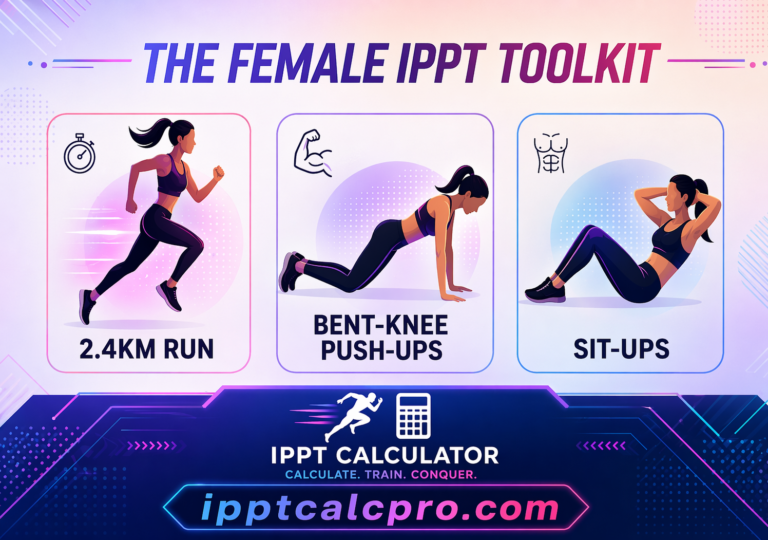
IPPT measures physical fitness through three exercises:
- Push-ups — upper-body muscular endurance
- Sit-ups — abdominal muscular endurance
- 2.4 km run — cardiovascular endurance
Each exercise contributes points toward a maximum score of 100.
For NSmen, IPPT is generally an annual fitness requirement, subject to eligibility, medical status, and applicable exemptions.
Taking the test at an FCC allows you to complete the required stations in an organized environment under the supervision of trained personnel.
Where Can You Take Your First IPPT at FCC?
There are four main FCC locations listed by MINDEF for SAF NSmen.
| Fitness and Conditioning Centre | What to know |
|---|---|
| Bedok FCC | An option for NSmen who prefer an eastern Singapore location |
| Khatib FCC | An option for those traveling from northern Singapore |
| Kranji FCC | May be convenient for those coming from northwestern Singapore |
| CMPB FCC | Located at the new Central Manpower Base; also accommodates eligible pre-enlistee testing |
You can select an available FCC based on your schedule and travel preferences.
Important: Maju FCC was replaced by the new CMPB FCC for IPPT and NS FIT sessions from October 14, 2025. Avoid relying on older guides that still list Maju as a current booking location.
Before leaving home, confirm the exact reporting address and entrance through your OneNS booking information.
Which FCC Should You Choose?
There isn’t one universally best FCC for everyone.
Consider the following:
- How long will it take to reach the center?
- Is public transportation convenient?
- Are morning or evening sessions available?
- Can you arrive without rushing?
- Are there specific reporting instructions for that location?
If two centers offer suitable appointments, choosing the one with the more reliable travel route may be more useful than choosing solely by distance.
How to Book Your First IPPT at FCC
For SAF NSmen, IPPT bookings are managed through OneNS.
You should book your session before traveling to the FCC rather than assuming walk-in testing is available.
Step-by-Step Booking Process
Step 1: Access OneNS
Visit the official OneNS platform and sign in using the supported authentication method.
Step 2: Find the IPPT/NS FIT service
Open the IPPT/NS FIT eService from your account.
Step 3: Select IPPT
Make sure you choose an IPPT test session rather than an NS FIT training session.
Step 4: Choose your FCC
Review the available Fitness and Conditioning Centres and select your preferred location.
Step 5: Select a date and time
Choose an available session that gives you enough time to prepare and travel.
Step 6: Confirm your booking
Review the appointment details and save your confirmation for reference.
According to MINDEF, NSmen can book IPPT or NS FIT sessions up to three months in advance.
Booking deadlines also apply. Morning and afternoon bookings close at 0000 hours, while evening bookings close at 1200 hours on the test date.
Always follow the current booking information shown in OneNS.
Special Booking Rules for Pre-Enlistees
Pre-enlistee IPPT is not identical to the annual NSman IPPT.
Students enrolled in certain educational institutions generally complete their pre-enlistee fitness assessments through their schools.
Eligible individuals who need a separate attempt or retest may book through the appropriate OneNS service.
CMPB states that pre-enlistee IPPT appointments at CMPB FCC are conducted on Wednesdays, excluding public holidays, and must be booked by Tuesday before noon.
If you’re a pre-enlistee, check the requirements that apply to your enlistment category instead of following an NSman’s booking instructions.
What Time Should You Report for IPPT at FCC?
You must report 15 minutes before your scheduled IPPT session begins.
This is the official reporting requirement stated by MINDEF.
For your first visit, however, consider reaching the facility approximately 25–30 minutes before the session starts. That additional buffer can help you locate the correct entrance and complete any preliminary checks without rushing.
For example, if your appointment begins at 5:00 PM, your required reporting time is 4:45 PM.
Arriving around 4:30–4:35 PM gives you additional time to find your way.
IPPT and FIT@FCC Session Timings
The following is the published MINDEF schedule for FCC sessions.
| Day | IPPT sessions | FIT@FCC sessions |
|---|---|---|
| Monday | — | 5:00 PM, 7:00 PM |
| Tuesday–Thursday | 5:00 PM, 6:00 PM | 7:00 PM |
| Friday | — | — |
| Saturday | 7:30 AM, 5:00 PM | 9:30 AM, 6:00 PM, 7:00 PM |
| Sunday | 7:30 AM | 9:30 AM |
Session availability may change, so use your confirmed booking as the final reference.
MINDEF estimates that each IPPT/FIT@FCC session lasts approximately 1.5 hours, including registration, safety briefing, testing activities, and out-processing.
Avoid scheduling another important appointment immediately afterward.
What Should You Wear for Your First IPPT?
Comfortable sportswear is the sensible choice for an IPPT session.
You need clothing that allows unrestricted movement during push-ups, sit-ups, and running.
Recommended Clothing
| Item | Recommendation |
|---|---|
| Shirt | Lightweight athletic T-shirt or suitable sports top |
| Shorts | Comfortable exercise shorts |
| Shoes | Proper running shoes with adequate grip |
| Socks | Breathable sports socks |
| Accessories | Minimal accessories that won’t interfere with exercise |
Choose clothing and shoes you’ve already used during training.
Brand-new running shoes might look appealing, but testing them during your IPPT introduces unnecessary uncertainty about fit and comfort.
Avoid restrictive clothing, slippers, and casual footwear unsuitable for running.
If your booking instructions specify additional dress requirements, follow those instructions.
What Should You Bring to IPPT at FCC?
You don’t need a large sports bag for a routine IPPT session, but a few essentials can make the day more comfortable.
First-Time IPPT Packing Checklist
- Required identification, such as your 11B or other accepted ID
- Mobile phone with access to your booking confirmation
- Water bottle
- Small towel
- Comfortable running shoes
- Spare shirt or change of clothes
- Small bag for personal belongings
- Any necessary prescribed medication
- Payment method for transportation or other personal expenses
Check your booking instructions for the exact identification and entry requirements.
Avoid carrying unnecessary valuables, and follow the facility’s rules concerning personal belongings and electronic devices.
What Happens During Your First IPPT at FCC?
Knowing the process in advance can help reduce uncertainty.
Although the exact movement between stations may vary by facility, the overall procedure follows a recognizable pattern.
1. Arrive and Complete Registration
When you reach the FCC, follow the designated signs and instructions.
Staff may check your identity, appointment details, and eligibility before allowing you to proceed.
If you’re unsure where to report, ask the personnel on duty rather than wandering around the facility.
2. Attend the Safety Briefing
Before testing begins, participants receive instructions concerning safety and the conduct of the exercises.
Pay attention to:
- Exercise standards
- Station procedures
- Equipment instructions
- Safety precautions
- Directions from test personnel
If you have a health concern or feel unwell, inform the appropriate personnel rather than attempting to push through symptoms.
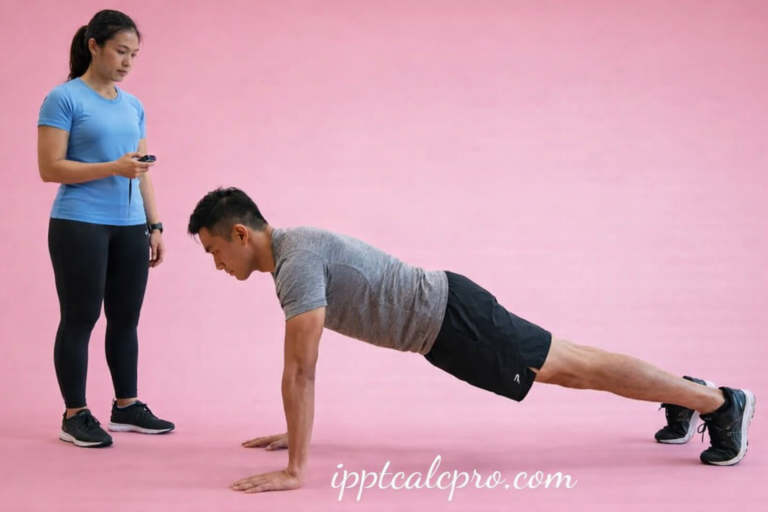
3. Complete the Push-Up Station
Push-ups measure upper-body muscular endurance.
You’ll have one minute to complete as many correctly performed repetitions as possible.
Your score depends on the number of valid repetitions recorded.
Focus on maintaining proper form rather than simply moving as quickly as possible.
Common mistakes include incomplete repetitions, poor body alignment, and losing control of the movement.
If the station uses automated counting equipment, follow the instructions for correct positioning and movement.
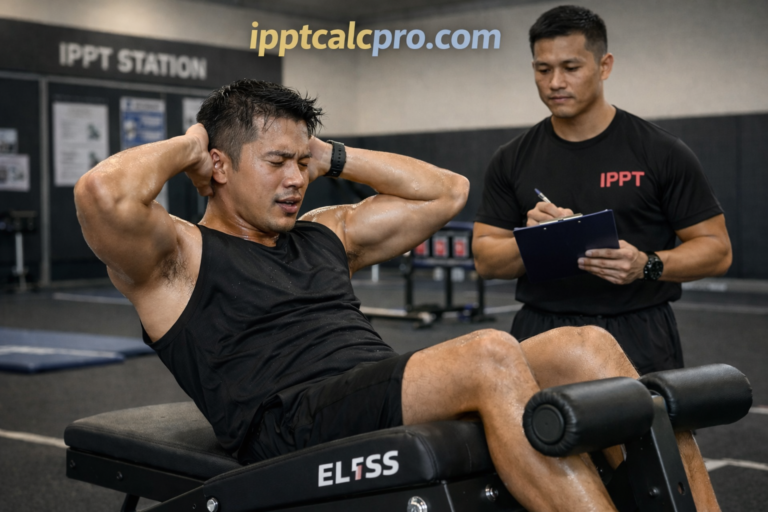
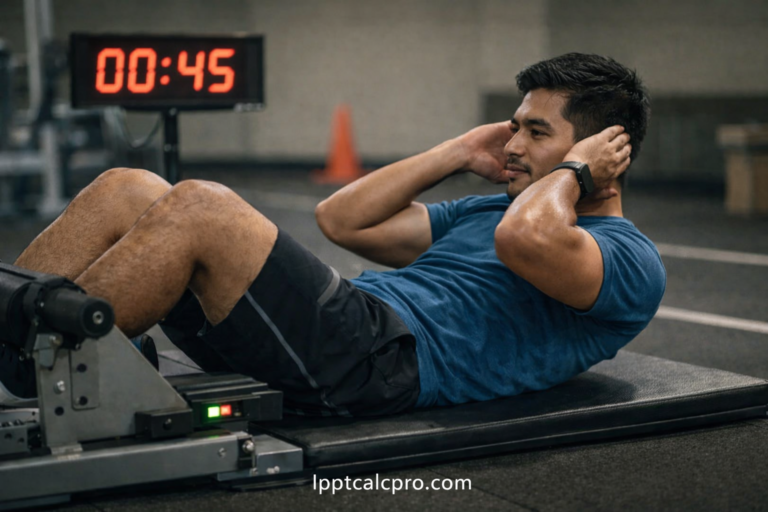
4. Complete the Sit-Up Station
The sit-up station measures abdominal muscular endurance.
As with push-ups, the test is conducted over one minute.
Try to maintain a controlled rhythm that you can sustain throughout the exercise.
Starting too aggressively may cause you to fatigue before the minute ends.
Practice the official movement standards during training so you’re familiar with what qualifies as a valid repetition.
Station-order note: MINDEF requires participants to complete the static stations before the 2.4 km run. The exact order of push-ups and sit-ups may depend on how the session is organized.
5. Complete the 2.4 km Run
The 2.4 km run is the final component of the standard three-station IPPT.
It carries the largest share of the total score, making it an important part of your overall result.
One common mistake is running too quickly at the beginning.
If you start at a pace you cannot maintain, you may struggle during the later stages.
Instead, choose a realistic target time based on your training performance.
For example, a runner targeting 12 minutes for 2.4 km needs an average pace of five minutes per kilometer.
On a standard 400-meter track, that would mean approximately two minutes per lap across six laps.
However, do not assume every FCC uses a 400-meter track. The actual running layout may differ between locations.
Follow the instructions provided at your FCC.
6. Receive Your Results and Complete Out-Processing
After completing all three stations, follow staff instructions for results and out-processing.
Your performance is assessed using the applicable IPPT scoring standards.
Review your result and verify your status through the appropriate official system.
If you do not achieve your target, your individual station scores can help identify where further preparation may be useful.
Understanding the IPPT Scoring System
IPPT uses a points-based scoring system.
Each station contributes to your overall score, but the available points are not distributed equally.
| IPPT station | Maximum points |
|---|---|
| Push-ups | 25 |
| Sit-ups | 25 |
| 2.4 km run | 50 |
| Total | 100 |
Your actual points depend on the applicable age-based scoring tables and your performance.
For standard NSman IPPT, a pass generally requires at least 51 points overall and at least one point from each station.
Additional award standards apply to higher scores.
Example: Planning Your IPPT Score
Suppose your practice results correspond to the following points under your applicable scoring table.
| Station | Example points |
|---|---|
| Push-ups | 15 |
| Sit-ups | 16 |
| 2.4 km run | 24 |
| Total | 55 |
In this hypothetical example, the participant earns 55 points, exceeding the standard NSman passing threshold, provided all station minimums are satisfied.
The purpose of calculating your score before test day is to understand which exercise deserves the most attention.
For example, improving your run might produce a greater benefit than adding a few more push-ups, depending on your current performance and age group.
You can use an IPPT Calculator to estimate your score before attending the FCC.
Remember that calculator results are estimates. Your official test result is determined by the applicable scoring rules and recorded performance.
How to Prepare for Your First IPPT at FCC
Good preparation doesn’t require complicated equipment or an extreme training routine.
The most useful approach is to practice the actual exercises and gradually improve your performance.
Practice Push-Ups and Sit-Ups Under Timed Conditions
Performing repetitions without a time limit is different from completing them within one minute.
During training, occasionally use a timer and record your correctly performed repetitions.
Focus on consistent technique and avoid sacrificing form for speed.
Train for the Full 2.4 km Distance
If you haven’t run regularly, build your endurance progressively rather than attempting maximum-effort runs every day.
A balanced routine might include easy running, appropriately paced intervals, and sufficient recovery.
Your training should match your current fitness and medical suitability.
Practice the Entire Test Sequence
Before your scheduled IPPT, consider completing a practice session that follows the same general order:
- Timed push-ups
- Timed sit-ups
- 2.4 km run
This can help you understand how the earlier exercises affect your energy levels before running.
Allow appropriate recovery between demanding practice sessions.
Prepare the Day Before
The day before your test is not the time for an exhausting workout.
Instead:
- Confirm your booking.
- Check your travel route.
- Prepare your identification and sportswear.
- Charge your phone.
- Drink fluids regularly.
- Eat familiar meals.
- Get sufficient sleep.
Avoid experimenting with unfamiliar supplements or unusually strenuous exercise immediately before testing.
Important Health and Eligibility Checks Before IPPT
Fitness preparation is important, but medical eligibility should come first.
If you’re injured, ill, or experiencing concerning symptoms, don’t attempt to complete the test simply to meet a deadline.
MINDEF advises unwell NSmen not to attend their IPPT or NS FIT session and to arrange another session after recovery.
For pre-enlistees, different absence-reporting procedures may apply, including contacting the NS Contact Centre and providing supporting medical documentation.
Health Screening for NSmen Aged 35 and Above
Certain NSmen must complete the SAF Health Screening Programme (HSP) before participating in IPPT.
MINDEF states that affected NSmen can make an advance booking, but they will not be allowed to take the test if their required screening has not been completed by the scheduled date.
If you’re 35 or older, check your HSP status through the official channels before booking.
Common First-Time IPPT Mistakes and How to Avoid Them
Small mistakes can make your first FCC visit unnecessarily stressful.
| Common mistake | Better approach |
|---|---|
| Booking the wrong session | Confirm that you selected IPPT rather than NS FIT |
| Arriving too late | Report at least 15 minutes before the session |
| Forgetting identification | Prepare your required documents the night before |
| Wearing unfamiliar shoes | Use comfortable running shoes you’ve already trained in |
| Starting the run too quickly | Follow a realistic pace based on training |
| Ignoring exercise standards | Practice correctly performed repetitions |
| Not knowing your target score | Estimate your points before test day |
| Attending while unwell | Recover and follow official rescheduling guidance |
One of the most useful things you can do is remove avoidable uncertainty.
If you know your booking details, reporting location, required equipment, and target score, you can concentrate on completing the exercises safely.
What Happens If You Fail Your First IPPT?
Failing your first IPPT doesn’t necessarily mean you’ve run out of options.
For NSmen, the next step depends on your IPPT window, eligibility, and remaining time.
Depending on your circumstances, you may be able to attempt IPPT again or complete the applicable NS FIT requirements.
If you’ve already attempted IPPT unsuccessfully, check whether that attempt counts toward your NS FIT obligations.
Your OneNS account and official MINDEF guidance should be your primary references for determining what remains outstanding.
What Is a Partial Failure?
A partial failure can occur when an NSman achieves at least 51 total points but does not satisfy the minimum requirement at a static station.
MINDEF explains that qualifying NSmen may need to complete a partial retest within 90 days or before their IPPT window closes, whichever comes first.
This is an important distinction because a high total score does not automatically mean every passing condition has been met.
First-Time IPPT at FCC vs. Pre-Enlistee IPPT
Although both tests assess similar fitness components, they serve different purposes.
| Feature | NSman IPPT | Pre-enlistee IPPT |
|---|---|---|
| Main purpose | Meet applicable annual fitness requirements | Assess fitness before enlistment |
| Booking | NSman IPPT/NS FIT eService | Appropriate pre-enlistee IPPT service |
| Locations | Eligible FCC locations | School-based testing or designated retest location |
| Score requirements | Standard NSman scoring and passing rules | Pre-enlistee requirements |
| Potential outcome | Annual requirement status and applicable awards | May affect eligibility for reduced full-time NS duration |
For eligible pre-enlistees, achieving at least 61 points, including the minimum station requirements, can contribute to qualifying for an eight-week reduction in full-time NS duration.
Additional medical, eligibility, and timing conditions apply.
Always check the official CMPB guidance for your enlistment intake.
Frequently Asked Questions About First-Time IPPT at FCC
Can I take IPPT at any FCC?
Eligible SAF NSmen can generally book an available session at Bedok, Khatib, Kranji, or CMPB FCC. Actual booking options depend on your eligibility and the sessions available through OneNS.
How long does IPPT take at an FCC?
MINDEF states that a typical IPPT/FIT@FCC session takes approximately 1.5 hours, including in-processing, safety briefing, and out-processing.
Do I need to book before attending?
Yes. You should make a booking through the appropriate official service and confirm your appointment before visiting the FCC.
Can I take IPPT without training?
You may be eligible to attempt IPPT without following a formal training program, but doing so without adequate preparation can increase the likelihood of poor performance or injury. Prepare according to your fitness level and medical suitability.
What happens if I arrive late?
Late arrival can interfere with registration and participation. Report to the responsible personnel for instructions rather than assuming you’ll automatically be allowed to join the session.
Is the 2.4 km run compulsory?
The standard three-station IPPT includes a 2.4 km run. Different requirements may apply to individuals with officially approved medical exemptions.
Can I use my phone during IPPT?
You can bring your phone for booking information and travel purposes, but its use inside the facility is subject to local security and testing instructions.
What if I feel unwell on test day?
Do not force yourself to complete a strenuous fitness test while unwell. Follow the applicable official absence and rescheduling procedures.
Can I retake IPPT after failing?
Depending on your eligibility and IPPT window, another attempt may be possible. Check your remaining obligations and available booking options through OneNS.
Is IPPT the same as NS FIT?
No. IPPT is a physical fitness assessment, while NS FIT is a structured fitness improvement program used to fulfill applicable fitness obligations.
Final Thoughts: Make Your First IPPT at FCC a Smooth Experience
Your first IPPT at an FCC doesn’t have to be complicated.
Most of the preparation comes down to a few practical decisions: book the correct session, arrive early, wear suitable sportswear, understand the three testing stations, and know what score you’re aiming for.
Take time to check your eligibility and health requirements before test day. If you’re unfamiliar with the process, pay attention during the briefing and ask staff for clarification whenever necessary.
Most importantly, prepare for the test according to your current fitness level instead of relying on last-minute effort.
Before your appointment, use an IPPT Calculator to estimate your score and identify where you may need improvement. Understanding your numbers in advance can help you approach your first FCC session with a clearer plan.
Information note: This guide reflects publicly available MINDEF and CMPB guidance reviewed in October 2026. Booking arrangements, eligibility requirements, and session schedules may change. Always verify your appointment and applicable rules through official Singapore government channels.