Pre-Enlistee IPPT: Your 61-Point Plan to Skip PTP
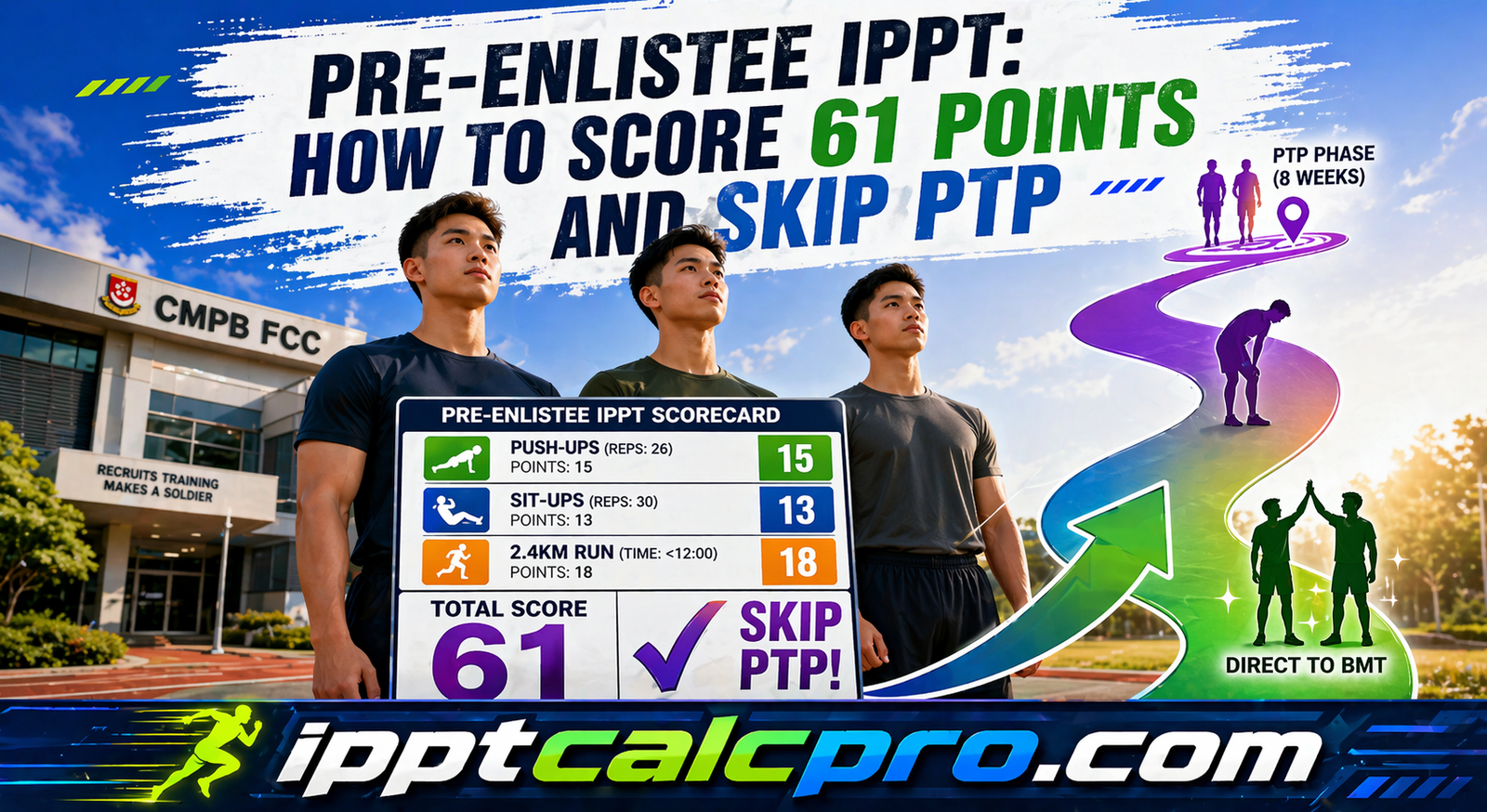
Pre-enlistee IPPT can help PES A and B1 recruits skip PTP and save 8 weeks of full-time NS, but only if they score at least 61 points with at least 1 point in each station: sit-ups, push-ups, and the 2.4km run, which matters most because it carries 50 of the 100 total points. Your result must be recorded at least 14 days before your PTP enlistment date, student results may already be sent through school, and everyone else must book Wednesday FCC tests through OneNS before the Tuesday noon cutoff. The best approach is to train with score tables and the IPPT Calculator, treat early attempts as practice, follow a balanced 6 to 8 week plan, train in real test format, respect recovery, avoid leaving the run to chance, and verify all rules with CMPB before making enlistment decisions.
What is the Reward?
The reward in pre-enlistee IPPT is very real. If someone offered me 8 weeks, or even Eight weeks, back from my full-time NS duration, I would take it without thinking twice, because that is part of your life you get to keep. That is why PTP exists in the first place: it is a system by design to build baseline fitness in recruits who are not yet ready for BMT or basic military training, but if you are already fit enough and show good fitness through a healthy lifestyle before enlistment, you can bypass that phase and go straight into basic training.
This option is only for PES A and B1 medical grade recruits, so your PES grade matters a lot here. If you are B2, B3, B4, C, or E, the training timeline and pathway in NS stay the same regardless of your fitness level. For boys under PES A and B1, the question is quite simple: is 6 to 8 weeks of consistent preparation before enlistment worth getting those weeks back later? For most people, the answer is yes, especially when you look at the long-term value and the practical details.
How the Scoring Works
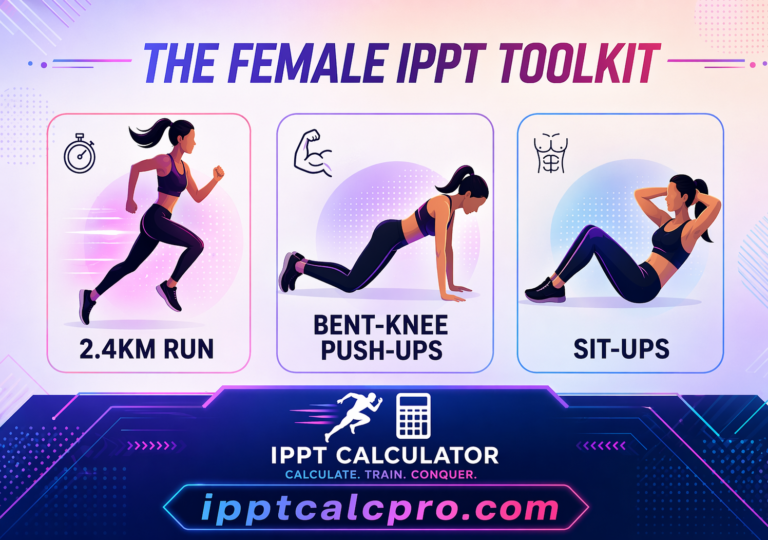
The IPPT has three distinct stations, and each one is designed to test a specific aspect of your physical fitness. You start with Sit-ups, which measure core strength and abdominal endurance in one minute through clean repetitions and can give you up to 25 points. Then comes the Push-up station, another one-minute sprint that checks upper body power, where form matters a lot just like in the first station, and this also has a maximum of 25 points toward your total grade.
The 2.4km Run is the ultimate test of endurance and leg stamina, and in my experience it is the most demanding part because it is weighted heavily at 50 points. That means the run alone carries as much value as the strength stations combined, so your pacing often shapes your final result more than people expect. Across all three, the full score is 100 points, and you need 61 to qualify for the 8-week benefit, but there is one important condition: you must get at least 1 point in every individual station, because scoring zero in a single station immediately disqualifies you from the benefit even if your total exceeds 61.
To understand your real target, use the official conversion tables like the Push ups Table, Sits up Table, and 2.4km run Table, which show exactly how many reps or what run timing equals how many points. These are available as downloadable PDFs, and I always tell people to check the Scoring Tables, Age Groups, and Pro Tips IPPT blog, then download the tables for each station, study the numbers for their age group, and shape their training from there instead of guessing.
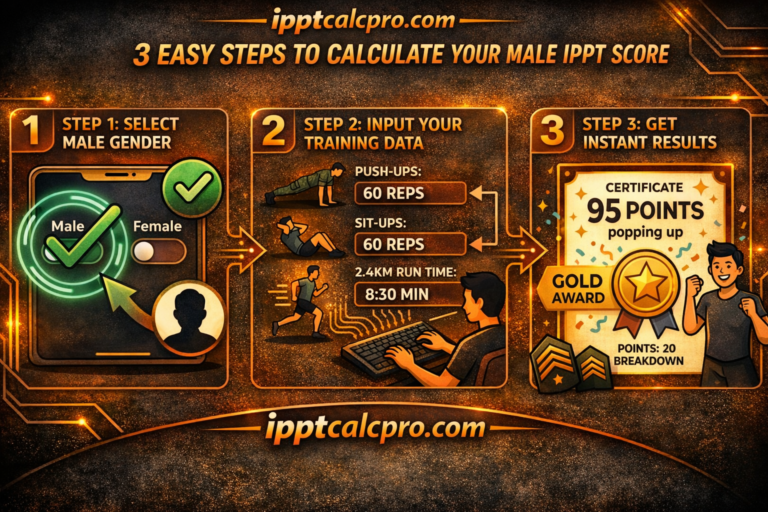
The biggest mistake many pre-enlistees make is that they leave points on the table in the run. A good run result can carry the bulk of your score, but many boys put all their effort into push-ups and sit-ups and still show up with a 13-minute run timing that sinks their total. Keep balance in your preparation, but give the run serious priority. A smart way is to use the IPPT Calculator to work backwards from 61, enter your current numbers, check your score, and adjust each station until you find the exact combination that gets you over the line with a specific training target instead of a vague fitness goal.
A Common Deadline Mistake
The most common mistake I see is people looking at the BMT date instead of the PTP enlistment date. Your qualifying score must be on record at least 14 days before your PTP enlistment date, and that is the date that matters. For example, if your enlistment is on 6 October, your last eligible test date would be 17 September. Any result after that will not count toward the 8-week reduction, even if you pass.
To stay safe, make sure you pass inside the eligible window. If you have already received your Enlistment Notice, CMPB can send a revised notice with your new enlistment date for the next available BMT intake. Your result remains valid for one year from the date of the test, so if you pass early, you do not need to retake it.
Where the Test Takes Place and How to Book
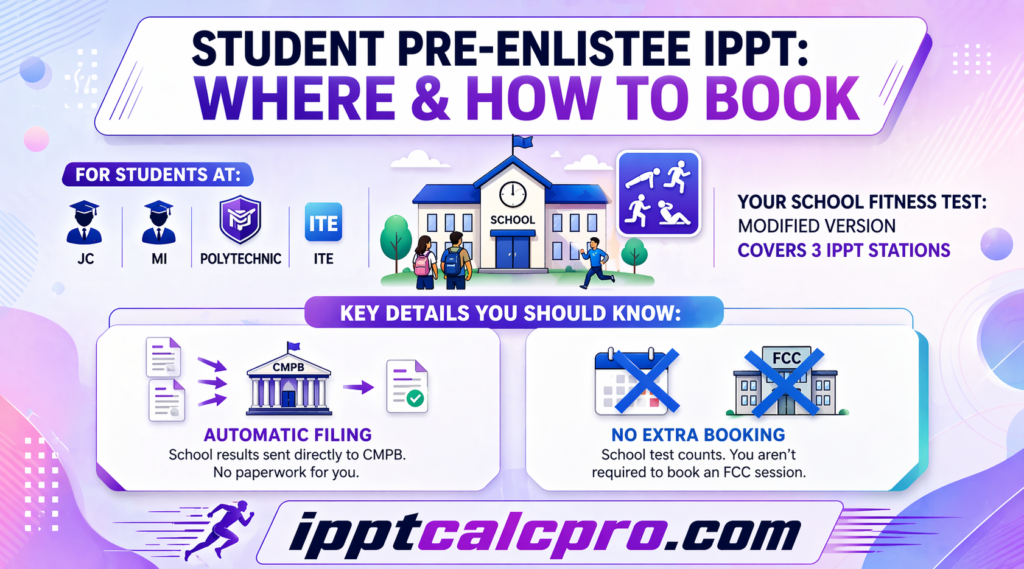
If you’re a student at a
- Junior College (JC),
- Millennia Institute (MI),
- Polytechnic, or
- ITE,
Here is how your fitness testing works in practice:
your school already conducts a modified version of the national fitness test, and this setup specifically includes the three IPPT stations needed for pre-enlistees.
Important details you should know:
Automatic Filing: You do not need to stress about any paperwork because your school sends the results straight to CMPB for you.
No Extra Booking: Because your school test already counts, there is no need for you to book a separate session at a Fitness Conditioning Centre (FCC).
Optional Re-takes: An external session only makes sense if you are not satisfied with your school score and want to push for a higher award, a better timing, or simply give yourself another attempt independently. From what I have seen, this can be useful for someone who was close to the target but knows he has more in him on a better day.
For everyone else, the test runs every Wednesday at the CMPB Fitness Conditioning Centre, except on public holidays. Appointments are mandatory, and walk-ins are not accepted, so you must complete your booking through the OneNS portal. If you want a Wednesday test date, make sure you book by noon on Tuesday because once the 12:00 PM cutoff passes, you have to wait until the following week.
The “Unlimited Retest” Strategy
Even though the system allows only one active booking at a time, there is no need to worry because you can still take the IPPT as many times as you need.
The Workflow: Take the test on Wednesday, and if the result is not good enough for you, just book the next Wednesday and keep going until you are satisfied or your deadline arrives.
Pro-Tip: Do not treat your first attempt like it is your only chance. It is smarter to see it as a trial run, and if your score is not where you want it, you can simply book again for the following week.
6 to 8 Week Training Plan
Here is your practical game plan to train well and ace the test.
Weeks 1 and 2: Find your starting point
In Weeks 1 and 2, start with a full mock test and record your sit-up count, push-up count, and 2.4km timing, then put those numbers into the IPPT Calculator so you can see your current score and know exactly how far you are from 61, because good training begins when you know where to focus your attention; from there, run 3 times per week, keep two runs easy and comfortable, and use the third session to do a full 2.4km at your best pace and check your timing, while also doing 2 strength sessions per week for push-ups and sit-ups, using sets of 10 with short rest periods between sets.
Weeks 3 and 4: Introduce structure
In Weeks 3 and 4, bring more shape to your weekly running by adding one interval session where you run 400 metres at a faster controlled pace, then walk for 90 seconds, and repeat that cycle four to six times, because this helps your legs and lungs sustain a faster pace without blowing up early; at the same time, raise your strength sessions a little by doing three sets per exercise at your current maximum with 60 to 90 seconds rest between sets, which is a simple way to build control and progress without rushing.
Weeks 5 and 6: Simulate test conditions
In Weeks 5 and 6, start making your training feel like the real test day by doing one full 2.4km at maximum effort each week, then record your time and compare it with the score table, because this is the most important change at this stage if you want a realistic score; alongside that, use timed one-minute sets for push-ups and sit-ups, since 35 reps at a relaxed pace is very different from doing 35 reps in exactly 60 seconds with correct form, and I have seen many boys perform significantly lower on test day simply because they never practiced the actual format.
Weeks 7 and 8: Recover and test
In Weeks 7 and 8, the real work is already behind you, so this is the time to back off and let your body absorb the training; in the final week, deliberately cut your training load, keep things light and easy, and just do enough to stay loose, with zero heavy lifting or intense cardio for at least three days before your actual test date, because once you have built the fitness, panic-training at the last minute will not help and rest becomes the secret ingredient that turns all that sweat into peak performance on test day; then go online, book your Wednesday slot at CMPB FCC within the window, and keep your head clear.
Mistakes That Cost Pre-Enlistees This Shortcut
Don’t Leave Your Run Score to Chance
A very common trap in Pre-enlistees is focusing about 80% of their energy on maxing out push-ups and sit-ups, because it feels productive, but that strategy consistently backfires when the 2.4km run cannot match their calisthenics level; the run is worth half of the total available points across the three stations, so from day one your training should cover everything, otherwise you are just dragging your total down and making that 61-point shortcut harder to reach.
Rest is Part of Your Training Plan
Your body does not get stronger from sweating through every session alone; it actually improves during recovery, which is why daily training may look like dedication but often just leaves you tired and ends up stopping progress. In my experience, constant daily training usually brings fatigue and stagnation, and that is when people hit a wall without understanding why, so three to four focused sessions per week is often far more effective than seven, because more is not always better.
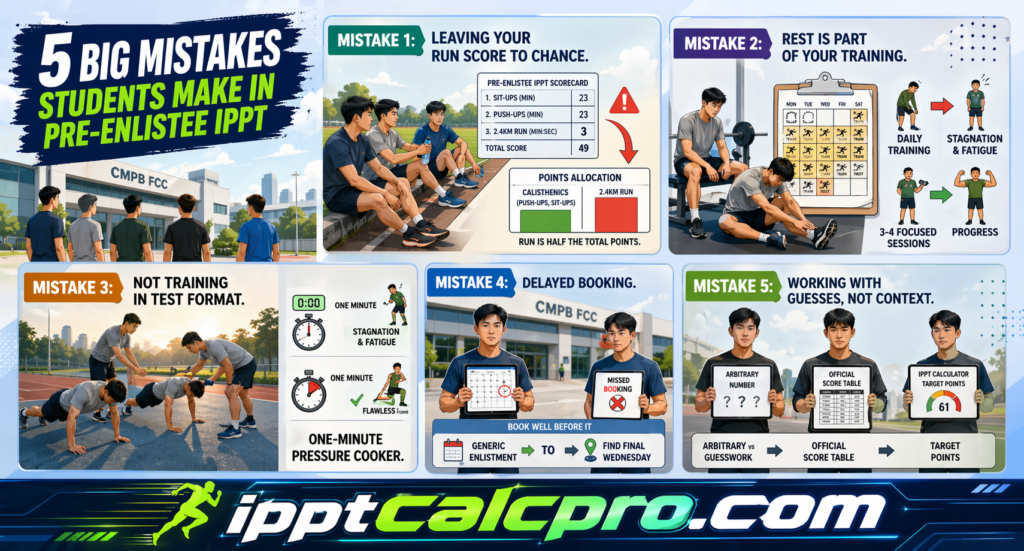
Train for the 1-Minute Pressure Cooker
The single most costly mistake I see is when people train in a way that does not match the test format, because on IPPT it is one minute, one monitored rep, then another one minute under pressure, and every rep must have flawless, correct form under the timer the entire time; if you have never practiced a timed set with proper form in training, then test day will feel like a completely different world and almost like a completely different test, which is why your practice must look as close to the real thing as possible.
Book Your Test Well in Advance
A critical logistical error many people make is to miss the Tuesday booking deadline, because there is only one test session per week, and once that happens your entire Wednesday chance is gone. From what I have seen, this kind of mistake hurts more than poor fitness because it wastes a real opportunity.
The smarter move is to work backwards from your PTP enlistment date, find your final eligible Wednesday, mark that specific date in your calendar, and book early, because this shortcut is too important to leave to the last minute.
Work with Context, Not Guesses
Going into training with arbitrary numbers for reps and hoping they somehow convert into enough points is like trying to drive a car blind because you are only guessing, and that is exactly why the official CMPB score tables are publicly available for a reason; download them before your first training session so you can see how your specific rep counts translate into a precise target instead of chasing a random guess.
What Test Day Looks Like at CMPB FCC
At CMPB FCC, try to arrive before your appointment time because the place runs on a schedule, and late arrivals can lose their slot, so bring your NRIC for registration and get yourself settled early; the three stations usually go in this order: sit-ups, push-ups, and then the 2.4km run, so take time to warm up properly since your full stay can be around 60 to 90 minutes including the test and registration.
Once you finish, your result is recorded digitally, and if your total reaches 61 with at least 1 point in each station, CMPB processes the outcome automatically; if there is success, a revised Enlistment Notice follows, and if not, you can rebook your next Wednesday slot before you leave.
Conclusion
Before making any decisions about your enlistment timeline, keep your focus on the rules, deadlines, score tables, and booking procedures shared in this article, then cross-verify them on CMPB’s official pre-enlistee IPPT page at cmpb.gov.sg; after that, use the IPPT Calculator to find your target score combination, train with a specific number in mind, and remember that if even one week feels worth the preparation, then 8 weeks is a reward you should seriously go after.